Since I can't reverse the order of the entries themselves, I suggest to anyone wanting to read the story from the beginning to use the Blog Archive in the column to the right, which lists the blogs in the correct order. Then read them scrolling from the bottom up.
Thanks for visiting,
E.A. Santangelo
Showing posts with label Editor Notes. Show all posts
Showing posts with label Editor Notes. Show all posts
Sunday, December 5, 2010


Wednesday, December 1, 2010
December 1, 1945
 Dec
Dec1 _____ The gang being transferred from the ship are all packing _ well get in tomorrow afternoon at 1600 so tonight well be my last night at sea. Its been a long cruise but its been a lot of fun _ If every thing goes alright I alto be heading home in 14 days.
_________
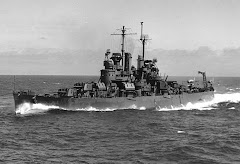
Photo shows part of the Mobile's Welcome Home festivities.
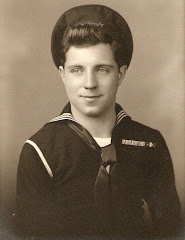
This is Joe's final entry. In the phrase "its been a lot of fun" above, a word is crossed out after "been." I've always wondered exactly what he started to write instead. I honestly don't think this was said in sarcasm. I think by "fun" he meant the friendships he made on board and the exotic places he'd seen. Still, an odd thing to write at the end of a war.
Friday, February 26, 2010
The 1945 Journal: Editor's Notes
 In 2 days I'll begin posting the 1945 journal entries. I'm taking a one day break first.
I intend to reproduce the journal exactly as Joe wrote it, only changing his spellings or adding punctuation where Joe's usage might cause confusion. All my additions will be in brackets. Joe's words will be in black. Anything added to the page by me will be in blue.
Joe only used apostrophes for "not" contractions. In an effort to keep the entries cleaner, I won't add them elsewhere. His meanings are usually obvious--just remember that the word "were" should often be read "we're." Also, Joe frequently forgot periods. To show where one sentence ends and another begins, I'll add an underline in a lighter color.
In places where damage to the book, spelling, or handwriting made words difficult to decipher, my guesses will be in brackets, or I'll insert a question mark in brackets where I don't feel comfortable hazarding even a guess. An ellipsis (three dots ...) will indicate where the page is ripped and words are missing.
Because it drives me nuts when I have figure out all the naval terms and abbreviations in books like TALES OF THE SOUTH PACIFIC, I'm going to put notes below each entry where necessary, for readers like myself who are clueless in such matters.
Lastly, I'll add footnotes in an attempt to clarify some of my uncle's references. Wherever I could find the information, if he gave a ship's number, I'll list the name. If he mentions damage, casualties, or the sinking of a certain ship, I tried to find more of the story, mainly to give you a better idea of what Joe witnessed, but also to honor those lives lost by passing on a tale they were never able to tell themselves.
Wednesday, February 10, 2010
TRUK
 February, 1944
In February, the Mobile, as part of Task Force 58, assisted with air strikes at Truk Atoll in the Caroline Islands, where the Japanese lost a large number of ships and planes, and in the Marianas Islands.
Because the force was sighted on its way to the Marianas, they suffered numerous attacks by both Japanese torpedo and dive bombers. The Mobile shot down two planes and assisted in the takedown of two more. During one of these attacks, "a bursting anti-aircraft shell fired by another ship sprayed the starboard side of Moe with shrapnel, injuring thirteen men, one of them seriously."
Quotes from Captain Lewis's War Record and Ship's History of U.S.S. Mobile.
_________________________
From the Data section of Joe's Journal:
8 - Caroline Is. _____________ Feb, 12, 1943*
Truk } air strike _ we sank 24 ships & 7 more probably sunk & destroyed 288 planes.
9 - Marianas Is. ____________ Feb. 22, 1944
Saipan __ } air strike _ Mobile shot down three more
Tinian __ } planes. #
* Joe mistakenly put 1943. Should have been 1944.
# The Mobile was actually credited with 2 takedowns and 2 assists.
Tuesday, February 9, 2010
January, 1944
 The U.S.S. Mobile left the West Coast January 13, 1944, making a stopover at Lahaina Roads, Maui--the last they'd see of Hawaii for nearly a full year.
Their first destination was the Wotje Atoll where, along with three other cruisers and six destroyers, the Mobile bombarded the shore under sporadic fire from Japanese shore batteries. One of the destroyers, the Anderson (photo), was hit, killing her captain and 5 men, and wounding 14 more.
After Wotje Atoll, Task Force 53 force provided fire support for the landings on Roi and Namur Islands. Once the Marshalls were taken, the fleet was again reorganized and the Mobile was assigned to Task Force 58 for, essentially, the next eleven months.
___________________________
From the Data Section of Joe's Journal:
7 - Marshall Is. ______________ Jan. 30 1944
Roi _________ } air strike & shore bombardment landed
Namai _______ } troops which took them.
Kwajalein _____}
Wotje ________} except Wotje.
Monday, February 8, 2010
U.S.S. MOBILE'S FIRST CASUALTIES
 December, 1943
The Central Pacific Force regrouped once more and the Mobile was assigned to Task Force 50, which proceeded to the Marshall Islands for preliminary air strikes on December 4 and 5, 1943. The amazing photo shows what the strike force looked like from the air.
As they were leaving, the task force was heavily attacked by Japanese planes for, according to Joe, "7 hours." The Mobile assisted in the takedown of one plane. Sometime during this operation, "a five-inch shell exploded in a 40MM mount, killing two men and wounding twenty-three, eight of them seriously" and causing a fire. These were the Mobile's first personnel casualties.
Although it's unclear exactly where repairs were made, the ship spent just over two weeks at Pearl before being sent on Christmas Day back to Long Beach, California for "rehearsals" of the forthcoming landings on the Marshall Islands, scheduled for late January. Their assignment this time was to Task Force 53, the Northern Attack Force. The Moe would assist in the assaults on Roi and Namur Islands of the Kwajalein Atoll in the Marshalls.
Quotes are from Captain Lewis's War Record and Ship's History of U.S.S. Mobile.
__________________________
From the Data Section of Joe's Journal:
6 - Marshall Is. __________ Dec. 15, 1943*
Wotje & Kwajalin Air strike we were attacked by Jap planes for 7 hours _ The Japs lost 5 ships & unknown number of planes.
* The official war record states that the Marshall Island operation was December 4-5, 1943 and that "During the retirement from these strikes, the task force was under enemy air attack,during which Mobile's anti-aircraft fire assisted in the destruction of one plane. In mid-December the task force returned to Pearl Harbor." The ship's cruise book lists them back in Pearl by December 9. Since Joe probably wrote this nearly 2 years later, he may have simply mis-remembered the date. Or his pen slipped and it just looks like a "1".
Sunday, February 7, 2010
GILBERT ISLANDS
November 20, 1943
After her first six months, the Mobile's crew began calling their ship the "Mighty Moe" (not to be confused with "The Mighty Mo", the nickname of the battleship Missouri).

After a two-day breather at Purvis Bay, Florida Island, the Mobile was sent back to the Gilbert Island operation, where on November 20 she provided shore bombardment for the landings on Tarawa Island. Though the operation was considered a success, nearly half of the more than 6000 Marines landed became casualties, and a third of those died.
Joe mentions in the back of his diary that a carrier was sunk during the operation. The escort carrier USS Liscome Bay (photo), on her first and last mission, was struck by a torpedo fired from a Japanese submarine at 5:10 AM on November 24. The huge explosion sent flames a thousand feet into the air. Seconds later the bombs stored in the Liscome Bay's hold detonated, blowing apart the entire back third of the carrier, showering ships as far away as 1500 yards with debris and human flesh. The ship went down 23 minutes later with the loss of her captain, Admiral Mullinex, 53 officers and 591 men. Of the 272 others were rescued, many were horribly burned, disfigured and blinded, and all were coated with fuel oil.
In such incidents throughout the war, the Mobile frequently assisted either search and rescue efforts, or provided a defensive screen for the rescuing ships. Joe later spoke to his sister of having seen bodies floating in the water during many of these rescues.
Details of the Liscome Bay sinking are from Morison's History of United States Naval Operations in World War II, Volume 7.
________________________________
From the Data Section of Joe's Journal:
5 - Gilberts Is. __________ Nov. 20*, 1943
Tarawa & Makin. Air strike & shore bombardment & landed troops captured it in 76 hours. We lost 1 aircraft carrier & 1 destroyer.#
* Some sources list this as Nov. 21, saying the 20th was by "Pearl Harbor Time."
# The carrier Joe mentioned was the Liscome Bay. However, the light carrier USS Independence was also hit by a torpedo from a plane. The Independence didn't sink, but 12 men were killed, 5 missing-in-action, 43 wounded.
After her first six months, the Mobile's crew began calling their ship the "Mighty Moe" (not to be confused with "The Mighty Mo", the nickname of the battleship Missouri).

After a two-day breather at Purvis Bay, Florida Island, the Mobile was sent back to the Gilbert Island operation, where on November 20 she provided shore bombardment for the landings on Tarawa Island. Though the operation was considered a success, nearly half of the more than 6000 Marines landed became casualties, and a third of those died.
Joe mentions in the back of his diary that a carrier was sunk during the operation. The escort carrier USS Liscome Bay (photo), on her first and last mission, was struck by a torpedo fired from a Japanese submarine at 5:10 AM on November 24. The huge explosion sent flames a thousand feet into the air. Seconds later the bombs stored in the Liscome Bay's hold detonated, blowing apart the entire back third of the carrier, showering ships as far away as 1500 yards with debris and human flesh. The ship went down 23 minutes later with the loss of her captain, Admiral Mullinex, 53 officers and 591 men. Of the 272 others were rescued, many were horribly burned, disfigured and blinded, and all were coated with fuel oil.
In such incidents throughout the war, the Mobile frequently assisted either search and rescue efforts, or provided a defensive screen for the rescuing ships. Joe later spoke to his sister of having seen bodies floating in the water during many of these rescues.
Details of the Liscome Bay sinking are from Morison's History of United States Naval Operations in World War II, Volume 7.
________________________________
From the Data Section of Joe's Journal:
5 - Gilberts Is. __________ Nov. 20*, 1943
Tarawa & Makin. Air strike & shore bombardment & landed troops captured it in 76 hours. We lost 1 aircraft carrier & 1 destroyer.#
* Some sources list this as Nov. 21, saying the 20th was by "Pearl Harbor Time."
# The carrier Joe mentioned was the Liscome Bay. However, the light carrier USS Independence was also hit by a torpedo from a plane. The Independence didn't sink, but 12 men were killed, 5 missing-in-action, 43 wounded.
Monday, February 1, 2010
Physical Characteristics -- The Journal Entries
 At the beginning, Joe's entries were made in blue ink in a small, even script. A neat, straight, red line separated each day and, to define the left margin, he traced another straight red line over the existing first ledger column separation. At intervals of five to ten days, below that day's entry, Joe wrote in red ink how many days he'd been "out of the states" that year. Also, as they headed west from Pearl, Joe noted time changes in red ink.
On April 8, less than a week after they joined the bombardment of Okinawa, his writing began to lose some of its evenness. He crossed out words for the first time (though he did this rarely). On April 11th, he stopped retracing the left margin ledger line. On the 21st, a few days after an accident in his gun turret, he stopped separating the days with red lines. His handwriting became more of a scrawl.
During May, his grammar got worse and his word order often became confused. Since they were bombarding and fighting off air attacks twenty-four hours a day for weeks, this was likely the result of sleep deprivation.

Conversely, though, his entries regarding the ship's activities during the Okinawa operation became more and more detailed. Notations included times written in both military and civilian format. Accompanying ships were noted nearly every day.
Yet, on May 22, his entries suddenly became very terse. When they left Okinawa he began adding a bit more detail for a few weeks, but from the end of June through early August, he said very little.
September through December's writings are again more detailed, except when there was, as he put it, "not much doing" on board. After Okinawa, Joe wrote almost nothing about what he did when given liberty or recreation. His main pastime seems to have been watching the other ships.
Subscribe to:
Posts (Atom)