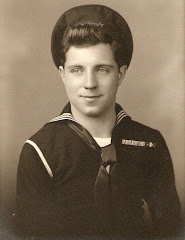
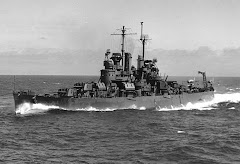
At the beginning, Joe's entries were made in blue ink in a small, even script. A neat, straight, red line separated each day and, to define the left margin, he traced another straight red line over the existing first ledger column separation. At intervals of five to ten days, below that day's entry, Joe wrote in red ink how many days he'd been "out of the states" that year. Also, as they headed west from Pearl, Joe noted time changes in red ink.
On April 8, less than a week after they joined the bombardment of Okinawa, his writing began to lose some of its evenness. He crossed out words for the first time (though he did this rarely). On April 11th, he stopped retracing the left margin ledger line. On the 21st, a few days after an accident in his gun turret, he stopped separating the days with red lines. His handwriting became more of a scrawl.
During May, his grammar got worse and his word order often became confused. Since they were bombarding and fighting off air attacks twenty-four hours a day for weeks, this was likely the result of sleep deprivation.

Conversely, though, his entries regarding the ship's activities during the Okinawa operation became more and more detailed. Notations included times written in both military and civilian format. Accompanying ships were noted nearly every day.
Yet, on May 22, his entries suddenly became very terse. When they left Okinawa he began adding a bit more detail for a few weeks, but from the end of June through early August, he said very little.
September through December's writings are again more detailed, except when there was, as he put it, "not much doing" on board. After Okinawa, Joe wrote almost nothing about what he did when given liberty or recreation. His main pastime seems to have been watching the other ships.